FOR EVMS TEAMS

What deploying MRC Academy looks like at your laboratory.

A pilot-first engagement model designed to fit DOE national laboratory operations — not to disrupt them. Start with existing on-demand modules, prove fit with a focused cohort, and scale on your terms.
A real excerpt from the program — actual narration, interactivity, and knowledge checks.

THE PILOT AT A GLANCE

Pre-Pilot · 2—4 weeks

Active Pilot · 8—12 weeks

Post-Pilot · 2—3 weeks

Single project, team, or cohort

No enterprise commitment to start

⸻ 
The MRC Academy Pilot Model

Pilot before you commit. Scale after fit is proven.

MRC Academy doesn’t ask laboratories to make an enterprise commitment before they’ve seen how the curriculum lands inside their environment. Phase 1 engagements start with a defined pilot — a single project, functional team, or cohort — running through existing on-demand modules in the same format your learners will use at scale. No custom curriculum development. No live workshops required. Just the curriculum as built, used the way it’s meant to be used.

This is deliberate. A laboratory’s project controls environment is shaped by its System Description, its tool ecosystem, its workforce composition, and its current surveillance posture. None of those are visible from the outside. The pilot creates the conditions for both sides to see whether MRC Academy genuinely fits — without either side committing to scope, customization, or pricing structures before fit is proven.

If the pilot succeeds, scaling is straightforward — additional projects, broader cohorts, or full catalog access. It can also expand into more tailored formats, including custom training and live or virtual-hosted instructor-led sessions, shaped around what the pilot teaches us and scoped accordingly. Either way, both teams finish with a clear, evidence-based read on fit — with no obligation beyond the pilot itself.

THE PILOT LIFECYCLE, END TO END

Three phases. Each jointly scoped with your team.

No template-driven engagements — each phase is calibrated to your project’s rhythm.

1

PHASE 1

Pre-Pilot

Typical duration: 2—4 weeks
The work that happens before any learner accesses a single module. This phase establishes whether a pilot is worth running and, if so, what success looks like.

WHAT HAPPENS

   Institutional Briefing

 A 60-minute conversation with your PMO and project controls leadership. We walk through the curriculum architecture, sample content, and the demonstration environment together.

   Cohort Design

Jointly identify the pilot cohort — which project, which roles, how many learners. We size the cohort to match your project’s rhythm.

   Module Selection

Identify which Phase 1 modules the cohort will engage with. Most pilots focus on Tier 1 Foundational Practice or a targeted subset.

   Success Criteria Definition

Agree on what we’ll evaluate at the end of the pilot. Each laboratory’s priorities differ; we calibrate jointly.

   System Description Alignment Review

A working session to map our curriculum against your site’s EVMS System Description so what learners encounter reinforces your governance.

2

PHASE 2

Active Pilot

Typical duration: 8—12 weeks
The pilot itself. Cohort engages with selected modules on a schedule that respects normal project workflow.

WHAT HAPPENS

   Cohort Enrollment

Learners are enrolled in the LearnWorlds platform. Administered centrally through your PMO or delegated by project.

   Module Engagement

Self-paced, web-accessible, completed inside normal workflow — not in dedicated training blocks.

   Mid-Pilot Check-In

A 30-minute working session at roughly the midpoint to surface friction, adjust pacing, and confirm we’re still tracking toward the success criteria.

   Progressive Visibility

Your PMO sees completion tracking, attendance data, and aggregate engagement through the platform’s administrative views.

   Active MRC Support

A named MRC consultant is available throughout the pilot for content questions, application discussion, or escalations.

3

PHASE 3

Post-Pilot

Typical duration: 2—3 weeks
The decision moment. Both teams review what happened against what was committed.

WHAT HAPPENS

   Joint Review Session

Working session with the same stakeholders who set the criteria at the start. We walk through the data and qualitative observations together.

   Learner Feedback Synthesis

Cohort feedback collected and reviewed — what worked, what didn’t, what should change before scaling.

   Scaling Decision

Clear go / hold / no-go. If go, we move into broader deployment planning. If it's not the right fit, both teams come away with a clear, evidence-based read — no obligation beyond the pilot itself.

   Broader Deployment Planning

If applicable. Engagement model selection, cohort expansion, administrative setup, and integration with your broader workforce development planning. Deployment can also take more tailored forms — see Additional delivery models below.

INTEGRATION WITH YOUR EVMS ENVIRONMENT

How MRC Academy fits your laboratory’s existing environment.

Three integration questions every laboratory PMO asks. Here’s how we answer them.

System Description Integration

MRC Academy is designed to reinforce, not replace, your site’s EVMS System Description. Curriculum content emphasizes consistency with how your laboratory documents its compliance with the 32 EIA-748 guidelines, and we run a pre-pilot working session to map our curriculum against your governance language.

Where our curriculum and your System Description use different terminology for the same concept, learners encounter both — so what they learn translates directly back to your local documentation.

Tool Ecosystem

Content references reflect common DOE laboratory project controls environments — including Primavera P6, Cobra, and PARS-related reporting contexts. Where your laboratory uses additional or specialized tools, we surface that during pre-pilot scoping so the curriculum supplements rather than contradicts your toolchain.

MRC Academy does not require integration with your project controls tools. It runs as a standalone learning platform; tool-specific application is reinforced through curriculum scenarios.

IT and Network Access

MRC Academy is web-accessible through the LearnWorlds learning environment, with no specialized learner software required. Administration is centralized through your PMO or delegated by project, with role-based access control.

We work with your IT and security teams during pre-pilot setup to align with your laboratory’s authentication, access, and data-handling policies — specifics depend on your site’s posture and are scoped jointly.

WHO SHOULD BE INVOLVED ON YOUR SIDE

Who from your laboratory should be in the room.

Integration questions surface across multiple functions — not because we need approvals.

ROLE

WHAT THEY DO

TYPICAL INVOLVEMENT

PMO Lead or Project Controls Manager

Pilot sponsor
Owns the scaling decision. Sets and reviews success criteria with us.
Briefing + mid-pilot check-in + post-pilot review

~4 hours total

EVMS Focal Point or System Description Owner

Governance alignment
Confirms curriculum alignment with site governance. Surfaces System Description integration questions during pre-pilot scoping.
Pre-pilot working session + ad-hoc Q&A.

~2 hours total

Pilot Cohort Lead

PM or CAM of the pilot project
Day-to-day point of contact during the active pilot phase. Surfaces friction in real time.
Mid-pilot check-in + light ongoing coordination.

~1—2 hours total

Cohort Leaders

CAMs, PMs, Analysts, technical staff
The practitioners completing the modules.
Self-paced module work, fit into normal workflow.

Cohort-dependent 

IT / Security Liaison

As needed
Confirms platform access fits site IT and security policies. Most labs handle this in one short conversation.
One scoping conversation pre-pilot.

~30 minutes

Procurement

As needed for scaling
Engaged at the post-pilot scaling decision if broader deployment moves forward. Not required for the pilot itself.

Post-pilot only, if scaling.

VISIBILITY DURING THE PILOT

What you’ll see while the pilot runs.

The LearnWorlds platform — which hosts MRC Academy — provides attendance tracking, module completion records, and certificates of completion for every participant. Your PMO sees aggregate engagement data and individual completion records through the administrative views.
Beyond platform-level visibility, success criteria for your laboratory’s pilot are defined jointly during the pre-pilot briefing. Each laboratory’s priorities differ — surveillance readiness, capability gaps in specific roles, workforce development pathways, or a combination — and the right success indicators reflect what your laboratory is genuinely trying to improve. We’ll talk through what success looks like for your context during the briefing.

BEYOND THE ON-DEMAND PILOT

Additional delivery models for laboratories that need more than the
standard curriculum.

Customized program development

Curriculum adapted to integrate your site's specific EVMS System Description, local templates, and tools. Delivered on-demand or through live or virtual-hosted sessions, depending on what fits your environment. For laboratories ready to commit to a fully localized training program rather than the standard on-demand curriculum.

Live-delivery formats

Existing Phase 1 modules adapted for live or virtual-hosted facilitated delivery. Useful for cohort-paced learning, team-based workshops, or program-launch events where you want consultant-led facilitation alongside the on-demand modules.

Both alternatives are scoped and priced per engagement. If either fits your laboratory’s needs, raise it during the briefing — we’ll talk through what’s possible.

AFTER THE PILOT

Three curated pathways for scaling EVMS capability.

After a successful pilot, MRC Academy is structured around three curated curriculum pathways. Each is built around a different workforce objective. We help you choose during the post-pilot scaling conversation.

These pathways scale with experience. Newer staff build from the foundational L1 tier, practitioners deepen application skill at L2, and seasoned CAMs, PMs, and analysts enter through the role-curated paths — with advanced scenario-based workshops (forthcoming) extending the program for the most complex EVMS challenges.
Phase 1 Bundle — Foundational + Compliance

For laboratory teams making EVMS capability part of their workforce development strategy.
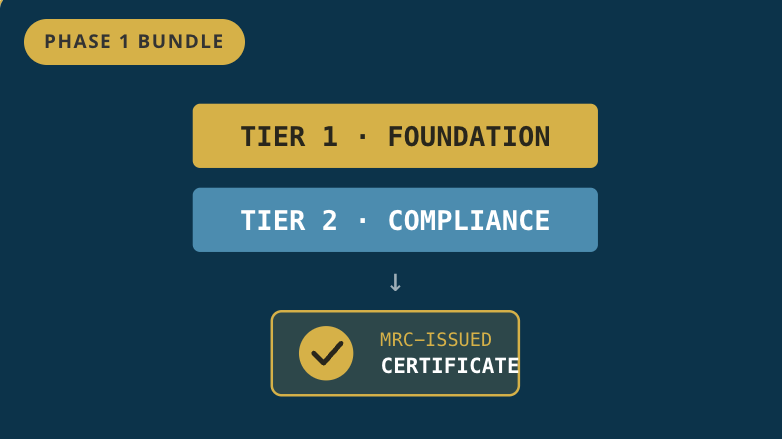
The complete Tier 1 and Tier 2 learning pathway. Combines all six Application modules at both L1 and L2 levels, structured as a single integrated learning journey. Learners who complete the Bundle and meet assessment requirements earn an MRC-issued EVMS Practitioner Certificate — awarded directly by Manta Ray Consulting.
Available Q4 2026.

CAM/PM Pathway

For Control Account Managers and Project Managers.
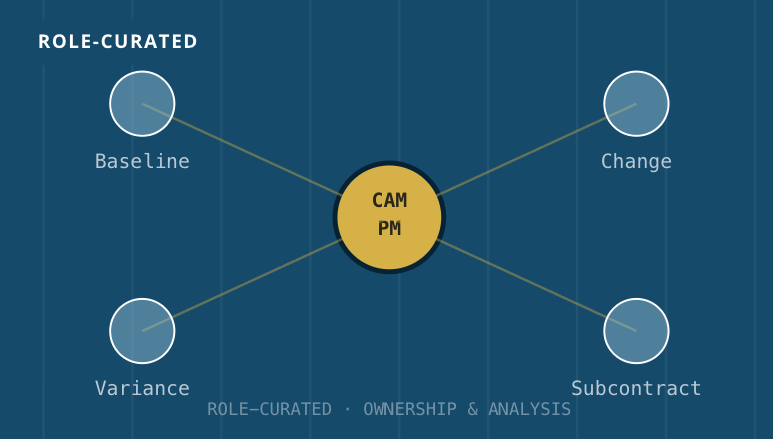
A role-curated path emphasizing the responsibilities CAMs and PMs carry — baseline ownership, variance analysis, change management, subcontract integration, and CAM interview readiness. Draws from across the Application and Governance Series with role-specific emphasis. Module composition is being finalized against pilot partner needs.


Pathway scope finalized through 2026.

Project Controls Analyst / Scheduler Pathway

For Project Controls Analysts and Schedulers.
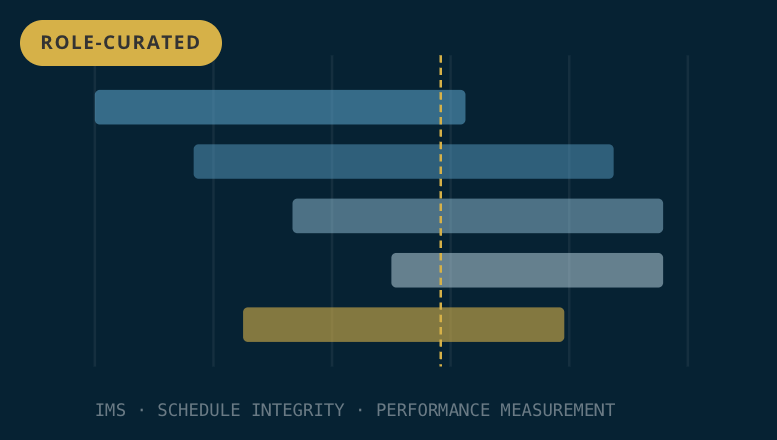
A role-curated path emphasizing the planning, scheduling, analysis, and reporting skills that support CAMs and PMs from the project controls function. Includes schedule integrity, IMS development, performance measurement fundamentals, and governance context. Module composition is being scoped against pilot partner needs.
Pathway scope finalized through 2026.

Modules can also be taken individually for targeted capability building, and full catalog access can be configured for laboratories
deploying broadly across multiple cohorts.

Ready to scope a pilot for your laboratory?

Request a briefing and we’ll talk through what a Phase 1 pilot could look like at your laboratory — cohort design, System Description integration, and the success metrics that matter for your environment.