
Training > EVMS Governance > Module 1

AVAILABLE 

DEMO AVAILABLE 

DOE O 413.3C TRANSITION

GOVERNANCE SERIES

DOE O 413.3C: Governance, Authority & Project-Control Decisions

What the Order changed, why, and how authority, assurance, and project-control decisions shift under it — worked through a running laboratory case.
What this module covers

What DOE O 413.3C changed from 413.3B and what did not — the March 2025 delegation of laboratory project authority to $300M, the expanded alternate-control path below it, contractor self-certification above it, and EIA-748 unchanged as the standard. What governs a project today: current policy versus the operative contract, and the EIA-748 version it requires. Whether EVMS applies and which framework; the governance mechanisms and authority paths; layered assurance. Right-sizing the implementation across schedule, cost, and analysis. Operating roles, approval and the evidence chain, subcontractor flow-down, rechecking the decision when facts change, portfolio governance, and the barriers to sound judgment. Worked on one branch of a fictional observatory program, with two further hypothetical projects carrying the authority decisions.

What you will be able to do

After this module you can

  • Determine what governs — identify the DOE requirements, contract obligations, and existing approvals that establish the project boundary.
  • Determine which project-control framework applies — compliant EVMS, PMSO-approved alternate project controls, or another contract-defined approach.
  • Distinguish the governance mechanism — tailoring, delegation, exemption, self-certification, internal delegation, or DOE surveillance.
  • Identify decision authority — who may recommend, concur, approve, implement, or modify the governing requirement or contractual obligation.
  • Support the decision with evidence — project facts, risk, complexity, approvals, and operating evidence — and recheck it when the facts change.
AVAILABILITY
Available
LEARNING HOURS
About 3.5 hours
AUDIENCE
Project Managers; CAMs; project management and project controls organizations; PMO and governance staff
PREREQUISITES
None enforced
ASSESSMENT
Section knowledge checks are ungraded. The module quiz is graded — 80 percent to pass, with retakes during your access period. 
RECOGNITION
MRC Academy Certificate of Completion · counts toward the EVMS Governance program certificate
ACCESS
12 months of access from purchase · named learner
PART OF
EVMS Governance

Per learner

$650
Buying for a team? Seats in any quantity, 12 months of access from purchase. For organizational orders, contact MRC Academy.
IN THIS MODULE
The decision you practice
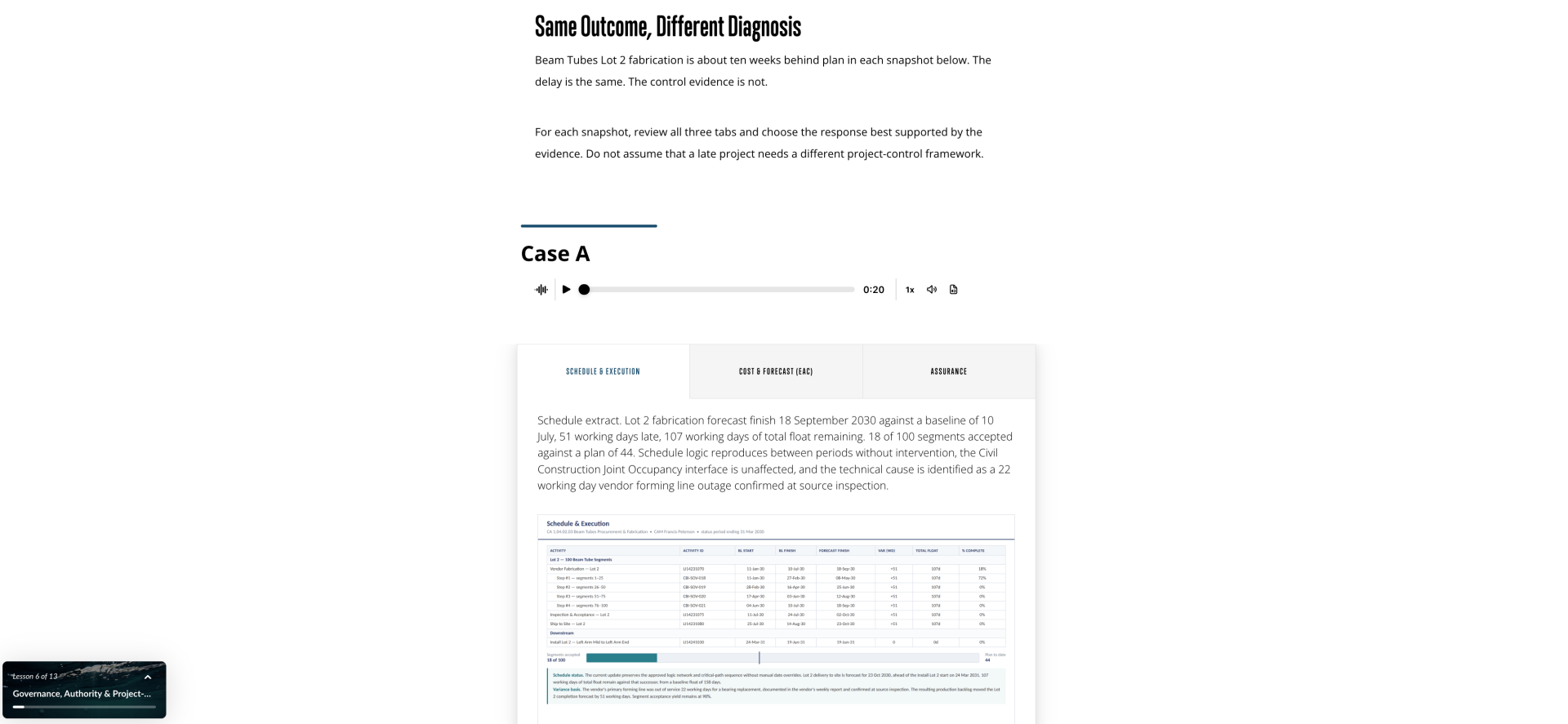
Beam-tube fabrication is ten weeks behind plan. In four snapshots of the same period the delay is identical — same schedule, same earned value, same forecast finish, and the slip still inside float. What differs is the evidence: whether the costs reconcile, what the forecast rests on, whether the schedule data can be trusted, and what assurance has already found. For each, you decide what the evidence supports — an execution problem, a control weakness, or something broader — and the proportionate response, then compare with the debrief.

How the module is built

Presentation lessons
Narrated video across six sections, from governance boundaries and authority to management value and the barriers to sound judgment.
Interactions
Seven narrated exercises in which you work the case artifacts before the debrief — three of them signature judgments: which path three projects take, four diagnoses of the same late schedule, and what would change your mind as the facts arrive.
Knowledge checks
At the end of each of the five content sections, two or three items each.
Module quiz
Seven scenario items, one best answer; a pass is 80 percent. Completion earns an MRC Academy Certificate of Completion for the module. The quiz can be retaken during your access period.
Job aids
Four ship with the module: a Governance Decision Sequence, a Governance Decision Compass, a Requirement-to-Evidence Crosswalk, and a 413.3B to 413.3C comparison. They are optional packaging — if your organization uses its own decision matrix or tailoring template, use it alongside them.