
Why these two modules together
DOE O 413.3C changed the governance framework for DOE capital asset projects — where authority sits, what assurance is expected, and how project-control decisions are made and recorded. Understanding the Order is the first half. The second is the environment the Order has to work in: the culture, people, practices, and resources that decide whether a system produces information leadership can rely on, or only information that satisfies review. The first module works through the Order; the second works through the environment. Together they give a team a shared way of reading the new requirements and a shared standard for what good looks like under them.
For project teams, PMOs, and governance staff moving from 413.3B to 413.3C. No prerequisites are enforced; the second module assumes working EVMS knowledge.
What's included
Two governance modules, in the recommended order. Each has its own page.
1
DOE O 413.3C: Governance, Authority & Project-Control Decisions
What the Order changed, why, and how authority, assurance, and project-control decisions shift under it — worked through a running laboratory case.
You practice: diagnosing four versions of the same late schedule from their evidence, not their indices — and choosing a proportionate response.
About 3.5 hours · Governance Series · Available · no prerequisites
2
Organizational Assurance & EVMS Maturity
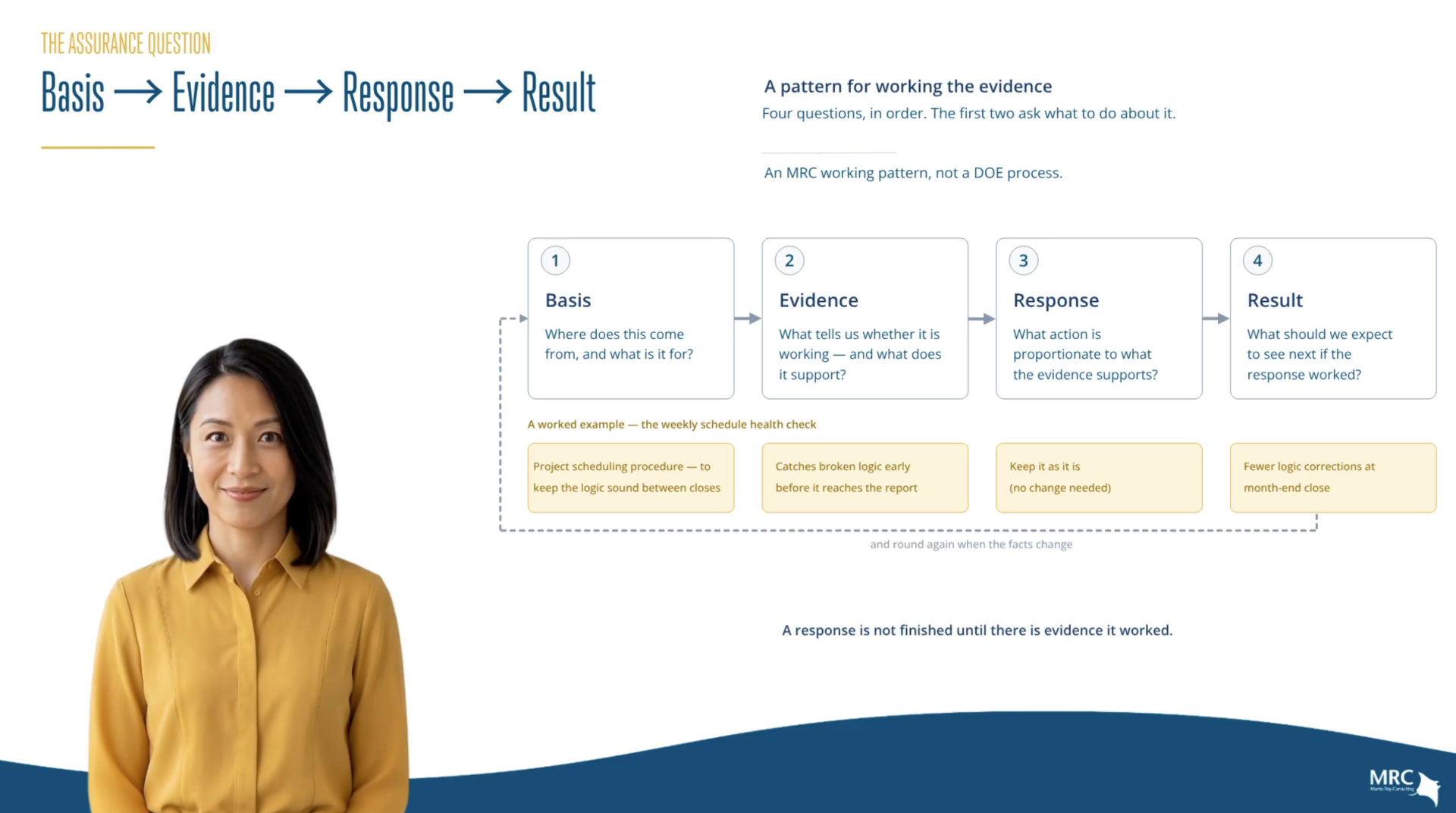
Once the system is approved and in use, how does a project team know it is still producing information it can rely on? Reading the evidence, the conditions behind it, and the proportionate response — under self-certification, and for projects under delegated authority.
You practice: reading six months of evidence on one control account and deciding what it supports — and what it doesn't yet.
About 3.5 hours · Governance Series · Available · assumes working EVMS knowledge
Job aids included: with the 413.3C module, a Governance Decision Compass, a 413.3B to 413.3C comparison, a requirement-to-evidence crosswalk, and the governance decision sequence; with the Assurance & Maturity module, the Basis, Evidence, Response, and Result team conversation guide. Optional packaging; the modules teach the underlying structure in full and your organization's own tools can stand in for them.
AVAILABILITY
Available
LEARNING HOURS
About 7 hours
AUDIENCE
Project teams, PMOs, governance staff
PREREQUISITES
None enforced · module 2 assumes working EVMS knowledge
ASSESSMENT
Section knowledge checks are ungraded. Each module quiz is graded — 80 percent to pass, with retakes during your access period.
RECOGNITION
EVMS Governance program certificate · module certificates of completion
ACCESS
12 months of access from purchase · named learner
INCLUDES
Five job aids: four with the 413.3C module, one with Organizational Assurance & EVMS Maturity
Per learner
$1,200
Less than the two modules purchased separately. Full pricing
Questions about fit for your team? Request a briefing — complimentary and optional.
Buying for a team? Seats in any quantity, 12 months of access from purchase. For organizational orders, contact MRC Academy.
What the program prepares you to do
- Separate what current DOE policy requires from what the operative contract requires, and say what 413.3C changed and what it did not.
- Determine which project-control framework and governance mechanism apply to a project, and who holds the authority to recommend, concur, approve, or modify.
- Support a governance decision with project facts, risk, approvals, and operating evidence — and recheck it when material facts change.
- Trace where a practice gets its authority and read the evidence that the system is working: traceable data, credible forecasts, forward-looking signals, management use.
- Recognize the conditions behind the evidence and choose a proportionate response, from correcting an item to escalating with evidence.
- Decide what a project under delegated authority should maintain, and what a proportionate response looks like.
ONE KIND OF PROJECT, BOTH MODULES
A fictional observatory program, modeled on LIGO
Both modules work the same kind of project: a large laboratory construction program with precision fabrication, long-lead subcontracted equipment, and demanding technical interfaces — a fictional observatory modeled on LIGO, so the setting is recognizable to a DOE audience. In the first module you work through the Order as it applies to one branch of the program's work: what governs the project today, which framework applies, who holds each decision, and what evidence a defensible decision needs. The second module returns to the same kind of work with the system approved and in use, and asks whether the information those decisions rest on can be relied upon — and what to do when it cannot.
How the modules are built
Presentation lessons
Narrated video explaining each element of the framework, why it exists, and how it is applied.
Interactions
Narrated exercises in which you work the case artifacts before the debrief.
Knowledge checks
At the end of each section, or as required judgments inside the interactions, depending on the module.
Module quiz
Graded; a pass is 80 percent. Completing both modules earns the program certificate. Each quiz can be retaken during your access period.

The training arm of Manta Ray Consulting — Earned Value Management for DOE national laboratories.
© 2026 Manta Ray Consulting. MRC Academy is an MRC Consulting program.
12205 Binney Street, Omaha, NE 68164 · 877-MRC-0010 · info@mantarayconsulting.net